
The news is out!
Welcome, everyone, to my blog!
For my first* post, I am so thrilled to announce that my debut novel Pandora is due to be published in the UK by Harvill Secker in January 2022, with other territories to follow. It's been a long and arduous journey for me (to be covered in a future blog entry), and because I'm a massive advocate for demystifying how the publishing industry works I'd like to share this with you - all the way from the novel's origins, right up to its launch into the world and beyond.
It won't be like this for every book, I better say this straight off. Debut novels are unique and frightening creatures, but I'm hoping to savour this whole thing and not let myself become frightened by the enormity of it (the word 'try' is paramount here). As such it makes sense to document this now - not only for you, but for me. Because one day I'm going to look back on all of this and wonder what the hell happened and how. So, brace yourself - it's a long read ...
The process
When I got my final agent rejection in October 2018 for Infelice, I was already feeling rather down in the dumps. Aside from having to painfully accept the other 41 rejections for my first novel I'd received over the previous two years, life had recently given me a few emotional blows. So, when the rejection email hit my inbox during a particularly trying morning I took it rather badly, and I needed a few days to dust myself off. But dust myself off I did, and within two weeks I was thinking about the next project. I had been advised to look at writing something more international in scope and/or fairly high concept, and the agent linked me to a few Bookseller Rights Deal articles which demonstrated the kind of book I should be looking at in terms of marketable historical fiction (in this instance The Doll Factory and Vardø, later retitled The Mercies). While a part of me knew that writing to trends is a dangerous thing since they are always on the move, I knew the agent had a point. If I was to 'make' it I needed to up my game. Infelice, as much as I loved it - and still do - was never going to be a page-turner, certainly not one that would suit the debut novel market. But what would?
Although I had the agent's words ingrained in the back of my mind, I didn't actually set out to write something high concept with an international appeal. Nor did I set out to write something Grecian-based. The trend for such novels had not yet fully kicked off - Circe and The Silence of the Girls had only been released earlier that year, A Thousand Ships wouldn't appear until the year after. Other novels in the same vein would take a while to hit the bookshelves and by that point Pandora was well underway and I had no idea Greek myth would be so big. In fact, part of me worried that I had inadvertently missed the boat considering the publishing trends I was seeing had been conceived behind the scenes 18 months beforehand. However. As I said, I hadn't set out to write something Grecian-based. My one true historical love had and will always be the Georgian era ... it just so happened that the Georgians took a massive liking to Greek styling, evident from their use of its features in their architecture and fashions.
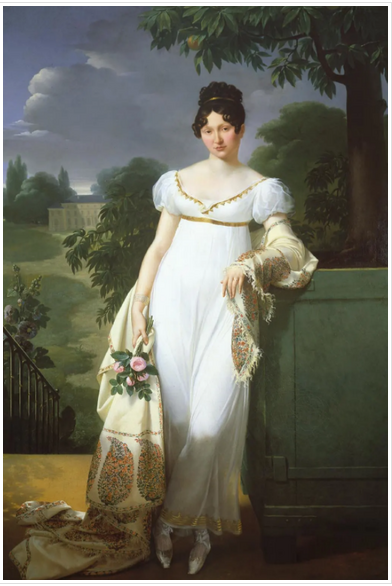
I wanted to set my novel in the Georgian era, that was a given; the Grecian influences were more little nuggets of ideas that I hadn't fully decided on. But by the time Christmas came I had the initial premise set out in my head, even if I didn't fully know where the story was going. I remember discussing it with my mum over an arduously long car journey, telling her how a certain magpie would be the perfect foil to my jewellery-making heroine, and feeling rather giddy at the idea. In terms of what inspired me to write about the Pandora myth itself ... well. The simple answer is, I just found the idea intriguing. As for an explanation of what else inspired me, you'll have to wait for my Author's Note when Pandora is published! (In the meantime, you can take a look at my dedicated page here.)
Despite having the initial premise ticking away in my mind, I didn't actually sit down to research the novel until the early summer of 2019. Ideas tend to latch themselves to my brain long before I even attempt to put notes to paper. I wanted to sit on it for a bit, consider how I felt about it six months down the line. I told myself that if the idea was strong enough I'd still have a good feeling about it. And I did. Somehow I knew I'd hit on something high concept despite not intentionally planning it that way.
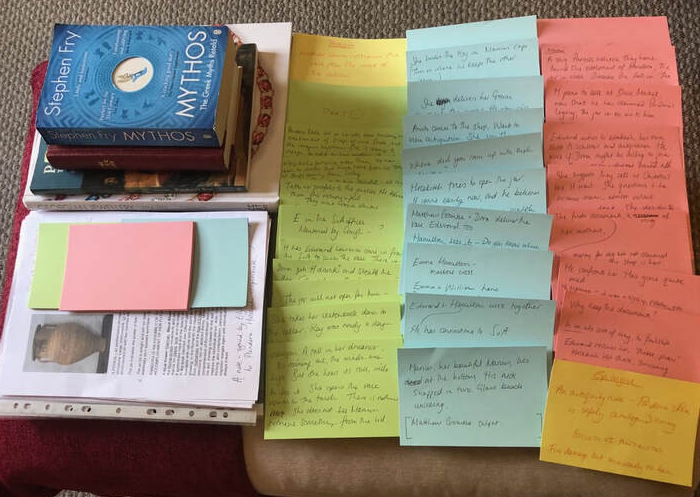
I am - in all aspects of my life - very much a 'planner'. Or so I thought. I'd planned the last novel meticulously and started to do the same with Pandora - see my wonderful array of coloured index cards as evidence! Except this time around I was writing something completely made up rather than retelling a true story, and I realised there was only so much I could plan ahead. I knew basic plot points, I knew what markers had to be in place. But as for the in-between bits it turns out I pretty much 'pantsed' Pandora the whole way through, making it all up as I went along. Because of that I often ran out of steam. These periods of ennui were also mixed in with the fact I was still working the day job at the time, and that took a lot out of me mentally. By December I had 52k of words. By January 2020 - having gone through a bout of crippling self-doubt and feeling wholly uninspired - I was ready to give up. I simply didn't know how to move the novel along to the ending I'd envisaged. I have since been told this is called 'the soggy middle', to which I can attest to now I've made it out the other side, but at the time getting past it felt impossible. In the end I reached out to Writing West Midlands as I am a member of their wonderfully supportive Room204 programme. It was suggested I attend their pitching workshop, which might help me find some clarity. And you know what? It did. However, it was decided I should take a break from it and put the novel away for three months, which I resolved to do. But then this happened ...
The competitions
Let's briefly backtrack. In the November - when I had about 48k of words under my belt - I decided to take a chance and send out the novel to the Lucy Cavendish Fiction Prize. I only needed to submit the first 15k, it didn't need to be finished, and I figured that if anything it would push me to finish the novel anyway. I honestly didn't think I'd get anywhere with LCFP since so many competitions I'd entered before all ended with disappointment (I should note I also entered the DRF Writers' Award, Mslexia and Bridport competitions with Pandora too, with no luck), so when I received an email in early March of 2020 saying I'd made their longlist I was floored. Delighted, but floored. It gave me a much needed boost to restart Pandora a few weeks earlier than planned. It even made me - on a complete whim - enter The Bath Novel Award, knowing that if I did get longlisted for that I absolutely had to finish the novel, no excuses. Turns out it was the push I needed because to my utter shock and delight, I got longlisted for that competition too. For all of half an hour I was giddy, until I realised what that meant. Cue utter and complete panic. I had five days to send them the full manuscript in order to be entered into the shortlisting.
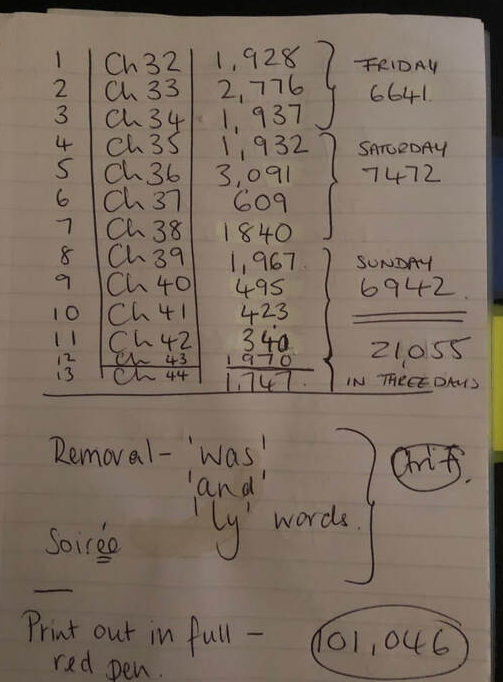
By this point I had written approximately 76k words. I had made a lot of headway in three months, but I wasn't near finished. I still, at that point, wasn't clear how to bring the novel to a close. On the left you can see what happened in the mad three days I had to finish it - if you look closely you'll see that's just over 21k of words I somehow managed to squeeze out! It was the most exhausting time of my writing career to date (though I have no doubt it won't be my last). Once I'd finished my Sunday words I went over to my neighbour who kindly let me use their printer, which took over an hour to print a 300+ page manuscript. I then proceeded to proofread the whole thing (I see things far more clearly when it's printed out in front of me) and pull an all-nighter as I implemented the changes. Monday morning I'd finished. Monday morning, I sent it off with a day to spare, and finally slept. It was the 29th June.
My plan had always been - before I sent to agents at all - to have a select few readers (betas) take a look at the novel, readers I'd already asked in advance. On the 30th I sent Pandora off to them. The BNA shortlist was due to be announced a month later and I knew that no matter what happened I would send out to agents by August 1st. It was my own internal deadline and I felt better having some modicum of control about the matter - I gave my beta readers until mid-July to get their comments back to me, so I could ensure I could sort out any issues before August.
As it turns out, I didn't make the shortlist. But, I did have a draft good enough for submission just over a year after first starting the novel. And that felt pretty good. If I add it all up and exclude busy work periods where I got nothing done, the gaps of writer's block, and allow for the time my beta readers had the novel, then from start to finish it took me ten months to write Pandora. The changes my betas came back with were so minimal that I hesitate to say there were two drafts of it before I sent out to agents. Usually I would have been hesitant to send a 'first' draft out into the world at all but I knew that the novel was as polished as I was going to get it, and with two big competition longlists behind me, I wasn't afraid to risk sending the novel out into the ether as it was.
The agent
The agent who sent that final rejection of Infelice happened to be Juliet Mushens. I'd already created a spreadsheet of agents I wanted to submit to, and she had always been on the top of my list ever since 2015. I sent Pandora to her with what I suppose was a quiet sort of confidence - a massive mental change considering how I used to feel about the submission process - but I had good reason. Off the back of the competition longlists and a marketing Tweet I’d posted, I'd already had some agents approach me and so I felt things would be different this time around, somehow. I sent to all the agents who had requested the full MS prior, and the typical sample package to the agents who hadn't (Juliet was one of these). I steeled myself for the usual three month waiting time, expecting to use that time to rest and think about the next novel. I was not expecting calls for the full MS from agents within the space of 48 hours, nor was I expecting five offers of representation within three weeks. This wasn't the way things normally happened! It was completely unprecedented! I felt rather numb about the whole thing, if I'm honest. None of it would sink in properly, not even when I ended up 'meeting' them all by Zoom or telephone to discuss their vision for Pandora, and for me as their client. As it was. one of the agents who offered me rep and had requested the full MS originally was on holiday, and I felt it only right to wait until they returned to chat with them too before making my final decision. This helped ground me a little. It was, though (and inevitable to be honest), Juliet who won out in the end - I had done enough internet stalking over the years to know that not only was she a fantastic agent but that she and I had very similar mindsets, liked many of the same things, and when we spoke over Zoom we just hit it off. Juliet felt 'right'.
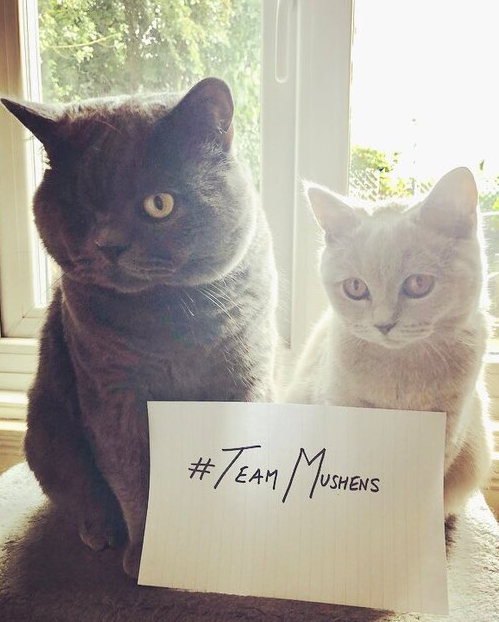
I accepted (or, rather, Byron and Brontë did) Juliet's offer of representation on 26th August. Within days we set to work on the edits. She gave me a list of things I needed to look at - thankfully they were all pretty minimal - and by the 19th September the novel was ready to submit to the editors Juliet had been busy making a list of who might potentially be interested. On the 21st ... the novel went out into the world.
Like the agent submission, the editor responses were pretty quick! Within a week Pandora had found a home.
The editor
I was in Wales visiting my mum when things began to move at a break-neck pace. A few times I was driving so couldn't answer Juliet's calls, another time I had no signal (Welsh mountain problems), so it wasn't the ideal situation for things to be kicking off! Juliet forwarded me so many lovely comments from the editors who had emailed her praising Pandora. There were some 'passes' too (editors that weren't interested), that was to be expected, but it was an incredibly humbling experience to know that there were people 'up there' who saw such potential in the novel. It was Liz Foley's first comment though that made me feel like she might be the right fit:
I thought I’d dip into this straightaway as it sounded so up my street and lo and behold four hours and several cancelled catch-up meetings later and I have finished and completely fallen head-over-heels for it! Susan is a fantastic writer (from the moment Lottie is described as ‘like tar on a gull’s wing’ I knew I was in for something special) and she conjures the high and low worlds of Georgian London with such evocative detail.
And it turned out she was rather keen! Within 24 hours Harvill Secker had offered a pre-empt (an advance offer to take the novel off the table and prevent it going to auction). I phoned Juliet sitting cross-legged on the kitchen floor in a complete daze. The thing is, I knew there were several other editors interested, and being so new at all this, and not being sure what to expect if Juliet took Pandora to auction ... I took the rather stress-inducing decision of turning Liz down! I fully intended to wait to see how the auction went, except that Liz and the team didn't want to take no for an answer. She put a second offer down on the table. Juliet set up a phone call between Liz and me - within hours she and I were speaking on the phone (I was sitting in my car outside the pharmacy in Barmouth with my mum in the passenger seat making bug-eyes at me), and it was evident from Liz's passion for Pandora that not only did she love it, but she understood my characters and what I was trying to achieve with the novel far more than I did! A few hours later Liz sent over the most phenomenal publishing pitch I could not have imagined even if I tried (I'd moved on to sitting in the car outside of Harlech Castle at this point), and I read it aloud with something akin to shell-shock. Well, that clinched it for me, and by the end of the day I had accepted Liz's offer. It was the 23rd September, just shy of a month of signing with Juliet (and a day before my mum's birthday to boot).
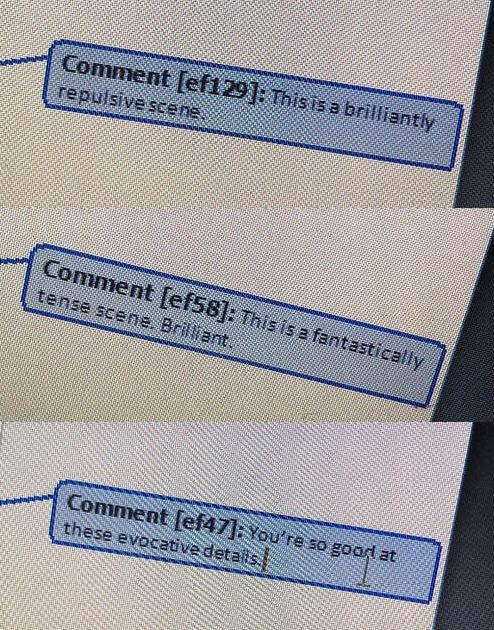
Today is February 12th, 2021. The past few months have been a bit of a whirr; contracts have been signed, I made the shortlist of the LCFP (a massive bonus) and three rounds of structural edits have been done (opposite are three of my favourite margin comments from Liz which gave me a very warm glow at the time). The press release was delayed for some weeks, but the wait has been worth it - Liz and the amazing team at Harvill Secker have been busy working on the styling and all manner of things in between and my novel - my darling miracle novel - is beginning to take shape. Proof's are imminent. The final jacket cover design is pending. You can already pre-order it. Pandora may not come into the world until January 2022, but it's starting now to feel very, very real.
Pandora publishes in January 2022, in hardback, ebook and audio.
You can find out more about Pandora or order your copy here.
*For those who have kindly kept tabs on me since 2014, you'll know that I went through a period of posting blogs here on this website. In the end I deleted them, having become very discouraged about everything and thinking how hideously precious, petulant and arrogantly misguided I sounded (I know, I know. That's also for a future blog post - it's all part and parcel of the writing journey).