

‘I will survive’ - AKA - How I navigated the submission process
“At first I was afraid, I was petrified ...
Well. Yeah. Cliché, maybe, but those song lyrics are kind of apt, aren't they, when you first start to think about sending your literary 'baby' out into the world. It's a terrifying experience because at the end of the day you're scared of rejection on two levels, both personally and professionally (and even though no agent would or should reject a writer on a personal level - it all balances on the strength of the writing - it sure as hell feels like it at first, and that's the sore).
Submitting is also a different experience for everyone - no one story is the same - so this isn't a 'how to submit to agents' blog post but a 'how I submitted to agents' blog post. There are plenty of those out there^ and you don't need another one from me. No, I'm sharing my personal experience with you simply so you can get a bit more of an idea about me, my journey, my thought processes, and hey, if it also helps you on your own submission journey that's all to the good. So, then, you ready? Let's dive in ...
A little bit of background info ...
My agent submission journey started not with Pandora but my first novel Infelice. It was a novel based on the true story of Sarah Walker, who became subject to the attentions of essayist William Hazlitt, a man twenty-three years her senior. He moved into her parent’s lodging house in August 1820 where he remained for nearly four years, and their disastrous relationship resulted in him publishing Liber Amoris, a book that caused scandalous ripples in Romantic circles.
It was (and remains) a story I was passionate about, a story that I felt needed to be told, and so I spent a considerable amount of time trying to make it work. This is why over the course of the agent submission process I also asked advice from two professional author-editors, sent the novel out to two open house submission windows, two independent publishers, a scholarship application for low-income writers, and entered it into three unpublished novel competitions (only one of these extra endeavours had any success*).
I wrote four drafts of Infelice before sending out to agents the first time, two more drafts before sending out a second time, and one more for the third. But before I sent anything out at all, I did my research.
Stage 1: the necessary homework
The very first thing I did was buy a copy of the Writers' & Artists' Yearbook. I went through every page and made a note of every single agent who was interested in historical fiction. Then I referred to the acknowledgements of some of my favourite historical novels to see who the author's agents were. After that I went online and did some internet stalking! This gave me a better idea of the agent - their tastes, personality, etc, to see if we might be a good match and therefore work well together. It was also an excellent way of finding out their track record for selling historical fiction and debut novels in general. By doing this I was able to create a longlist of between 20-30 agents. In order to create a shortlist I chose between these agents according to preference, and separated those into agents to send to first, then second. It was all a relatively simple process, albeit time consuming.
Nowadays trawling through a W&A manual might be a bit overkill since so much content is available online now (refer, for instance, to QueryTracker and AgentQuery, or even the power of a basic Google search), but if you prefer old fashioned physical searches then it's definitely worth investing in a copy, especially as it lists other things besides agents.
Prior to sending to these agents, though, I attended Juliet Mushens' Guardian Masterclass How to Hook an Agent. I'll save that for another post, but let's just say it was the perfect culmination to my research!
Stage 2: the power of spreadsheets
Once I knew who I was sending to I created a spreadsheet with individual tabs - Longlist, Shortlist, Sent - Round 1, Sent - Round 2, Longlist#2 and Sent - Round 3 (I didn't bother with another shortlist third time around). I found this massively useful since I'm an extremely organised person, and it meant I could keep track of the submission process at every stage.
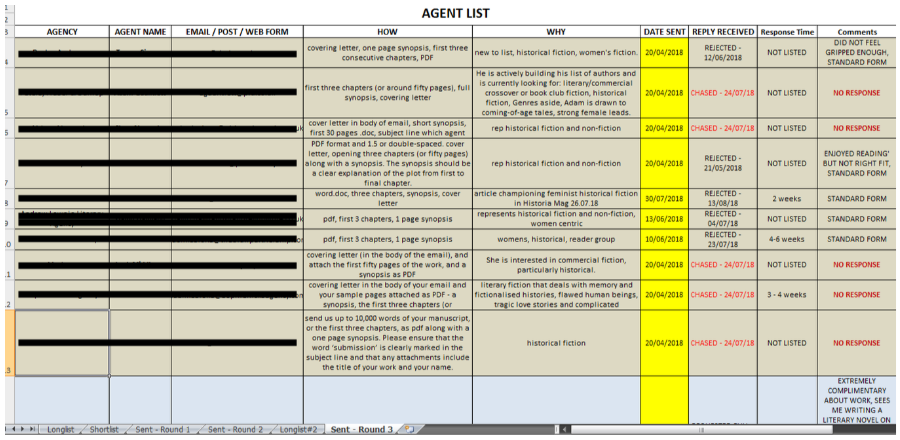
In columns I listed the agency name, agent’s name, whether they wanted the sub via email, post or web form and the relevant details. I listed why I had chosen them, the date sent, the reply received (if at all), the expected response time, any feedback comments if they were provided. I also noted their submission requirements in one column. More on that below.
Stage 3: the submission package(s)
Ah, the dreaded submission package. All were different and I amended per agent. There was only one rule that I used here and that was: GIVE THE AGENTS EXACTLY WHAT THEY ASK FOR. It was a simple request and not at all hard (if you arrogantly ignore their rules then you have already shot yourself in the foot before you've even begun).
In my case some asked for the first three chapters, some the first 50 pages. Some required page numbers, some asked for 12pt font double spaced, some didn't care as long as it was clear and neat and you didn't use a horrific typeface like Comic Sans. Across my two novels I created about 50 different submission packages depending on agent requirements (many asked for the same things, so all I had to do was amend the name and email address, and my reasons for sending to them), but others needed something too different for a copy and paste job. I kept a folder for each agent package I submitted - a Word document for the cover letter, and then whatever format the rest needed to be in (PDF, Word, etc). In all instances for me the cover letter was pasted into the body of the email, though some agents may ask for it in an attachment. The email subject header required a specific format as well. Typically mine was a variation of QUERY: 'NOVEL TITLE' by Susan Stokes-Chapman.
Stage 4: the waiting game
This was the worse part, really. Waiting. It was a mission - at least to begin with when all this was new - not to keep eagle eyes on my inbox and refresh it every ten minutes. And each time a response came in it was a sucker-punch to the gut. What no one warned me about was how needlessly cold and often rude some of the standard rejections were (for those of you who are new to the process, be wary of that - you'll need a stiff spine).
Infelice went through three rounds of agent send-offs: 2015-2016 and 2018. During the first round of queries I sent to eleven agents. Three gave no response, six gave the standard rejection. Two agents called for the full manuscript (one by phone, one by email). I was so thrilled when that happened, but I had to chase for their responses after several months. The one who phoned me sent a polite but brief email saying he admired my writing but did not feel he could sell the novel. The second sent me a wonderfully supportive and complimentary email saying that it was nearly a yes, but that in the end she felt the novel wasn't quite for her. That was pretty heart wrenching, I'm not gonna lie!
The second round of queries was a massive disappointment. Not even a bite. I sent to another eleven agents but this time received four no responses with the rest standard rejections (one agency rejected me three times off the back of the same submission, each email a few months apart!) At the time I was intensely miserable in my day job, and I became a little too dependent on achieving my dream - I felt success would rescue me, for want of a better word, and turn my life around. I wanted it now. So those rejections began to make me bitter. Unhealthily bitter. It was a debilitating experience. Still, I was stubborn enough not to give up on that dream (and thank god I didn't).
One agent I actually met. She was the one who rejected the novel in round one, but a month later did suggest we meet anyway - I went down to London with my heart in my throat but also with a gut feeling about the results, and they weren't positive. She was wonderfully friendly and encouraging, but I could tell she was sounding me out about my next project (which was totally different to Pandora and has since been relegated to the drawer of no-go ideas), and therefore ascertaining if we might suit. At no point did she say 'you aren't for me' but I knew that by the end of the meeting this was the unspoken agreement. I left her office feeling happy she had taken the time to see me (because this was an achievement in itself) but disappointed that I'd come so close without a 'win'. It was at that point I decided to take a break for a few months and begin yet another rewrite in the new year. This was in the autumn of 2016.
I spent about a year rewriting. I knew that this would be the last go of it, that if I didn't score that 'win' this time around then I would have to shelve the novel, because enough was enough; the idea for Infelice had been in my head since 2008 - ten years invested in a debut novel without return was beyond what any reasonable person should have done. I was, quite frankly, flogging a dead horse with that particular novel, but I owed it to myself and the story to try.
The submission process began again in spring 2018 when I sent to 18 agents. At that point I was in a different job I enjoyed, so that desperateness had abated somewhat and by this third round I was simply going through the motions (that second longlist of agents wasn't shortlisted because I knew this was my last try, and so just decided to blast the submissions out in one batch job). I had also sent a sample extract into the Writing East Midlands Writers' Conference of that year in the hope I would win an agent 1-2-1 for advice. I was lucky enough to win a spot, but imagine my shock and concern when the agent I'd been paired with was none other than an agent who had already rejected the novel back in 2015! But as it turned out the agent (yes, it was Juliet) really enjoyed my piece, and so I took a risk. I emailed her asking if she would be willing to see the novel again as part of a new submission, and I was both surprised and elated when she said she would. She requested the full manuscript soon after but ultimately passed on it, and so when that last rejection hit my inbox in October 2018 (seven no responses and ten standards in that final round) I came to accept 'that was that'.
Still, my first novel was not a waste of time - it taught me over seven drafts of the damn thing how to write, it peaked the interest of the agent who would finally sign me for my debut (Juliet said she loved my writing and that she'd be thrilled to read something else from me), and it did win one small accolade in the end. On a whim (when Pandora was already well underway and I'd long since discarded Infelice) I submitted the novel to the *2020 Sharpe Books/HWA Unpublished Novel Award and bagged a Highly Commended place. That was definitely something to be proud of.
Pandora
As you can probably imagine, because I'd already been through all of the above with my first novel, I did rather skip a step or two when it came to the agent search for Pandora. By this point I knew what I was doing and could do it blindfolded, but my last blog post does also outline part of the reasons why I didn't have to go back to the drawing board completely. Still, I did create a new spreadsheet based off who I knew I wanted to approach according to their likes/track record/other author's they represented, all with the same columns minus a longlist and shortlist. It just so happens that the level of interest I received was much greater because of Pandora's success prior to submitting. I am very aware of how lucky I have been, and will remain thankful to the Lucy Cavendish Fiction Prize and the Bath Novel Award for seeing the novel's potential.
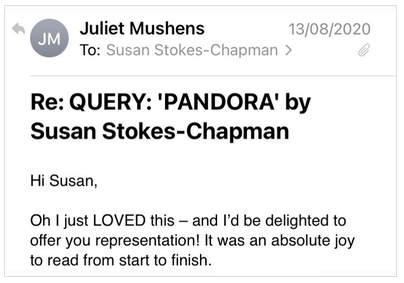
As you know, it was Pandora that won the day. Here's the magical moment Juliet offered me representation → (this isn't the whole email, of course, but those opening lines were like catnip to me after all those years of reading 'NO'!)
So, there we are. Please do remember, this is a blog post outlining my own personal experience of how I navigated the submission process and made it out on the other side. I had been querying on and off since autumn 2015, so it's taken a lot of commitment and belief (alright, pig-headed stubbornness) in myself and my writing to get this far. I hope you have found this post useful but as I said at the beginning - every experience is completely different, and you will naturally find your own way through what I know can feel like an impenetrable quagmire. But, if you persevere, you will get there. Faith, is everything.
Wishing you the very best of luck!
^For those who are looking for some generic 'how to submit to agents' blogs I would highly recommend the following:
Masterclass Article | Writers & Artists 10 Steps | TheWriter Magazine Do's & Dont's
^My amazing agency Mushens Entertainment also has some excellent blog posts related to the agent submission process:
How to Research Literary Agents | The Perfect Cover Letter | Pitch Perfect | The Dreaded Synopsis | Agent’s Advice